Home The Technical Indicator Series
Moving Averages for Beginners
Master the Five Essential MAs in Technical Analysis
Most books teach you one or two moving averages. This one teaches you five — completely.
Moving averages are on every chart on every platform used by every trader in the world. Most traders use one or two without fully understanding them. This book changes that.
Moving Averages for Beginners covers the five essential MAs — SMA, EMA, WMA, HMA, and SMMA/Wilder's — from first principles to complete trading systems. Each indicator gets its own chapter with the same structure: what it is and why it was designed, the exact formula and how to calculate it, the four signal types it generates, two historical trade examples with specific dates and prices, and the mistakes traders make that cost them money.
What makes this book different from every other moving average book:
- Five MAs, not two. Most beginner books cover the SMA and EMA and stop there. This book goes further — including the Hull Moving Average, designed specifically to reduce lag, and Wilder's Smoothed MA, the engine running silently inside RSI, ATR, and ADX on every platform you have ever used.
- 31 annotated charts. Every concept is illustrated with a full-page chart on a real instrument — SPY, QQQ, AAPL, NVDA, TSLA, META, BTC — at specific dates, with entry signals, exit signals, stop levels, and key events labeled directly on the chart. No vague examples. No charts that look nothing like what you see on your own screen.
- A complete trading system. Chapter 12 gives you a fully specified MA Swing System — market selection criteria, three entry conditions, stop placement rules, position sizing using the 1% rule, and exit signals — with a worked trade example and a 30-trade performance log showing how expectancy is calculated. You finish this book with something you can actually use.
- The failure modes no one talks about. Chapter 11 covers the five ways moving averages fail — whipsaw in range-bound markets, late exits at trend tops, gaps through MA levels, extension and mean reversion, and structural breaks — and what to do when each one appears. Most books only show you when MAs work. This one shows you when they don't, and why that knowledge is worth more.
- The decision framework. Chapter 8 gives you a four-question framework for choosing the right MA for any market, timeframe, and signal type. No more guessing which MA to use or why.
What you will know by the last page:
How each of the five MAs is calculated and why the calculation matters for how it behaves. How to read trend direction, price crossovers, MA crossovers, and dynamic support and resistance on any chart. How to combine MAs into dual systems, triple systems, and ribbons. How to trade MA bounces and role-reversals as standalone setups. How to recognize when your MA system is failing and what to do about it. And how to build a complete rules-based system around the MAs you choose.
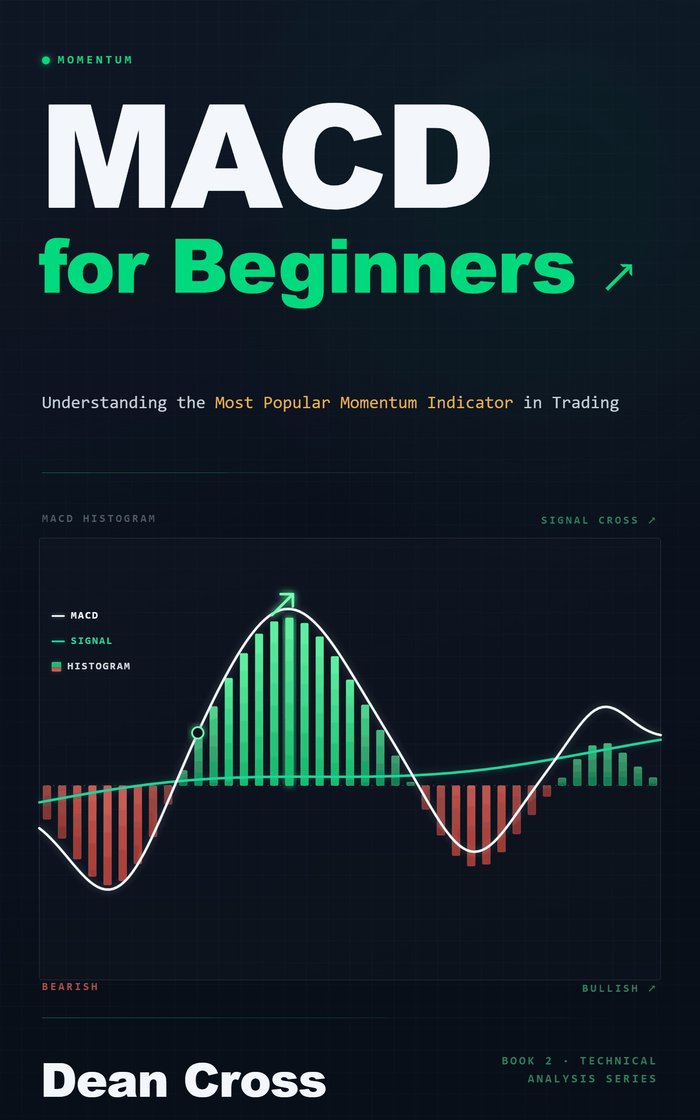
Part of Dean Cross's Technical Analysis Series — following MACD for Beginners and Squeezing Profits: Catch Volatility Breakouts Before They Happen. Each book stands alone. Together they form a complete technical analysis foundation.
267 pages. 31 charts. 13 chapters. One complete system.
If you are ready to understand moving averages the way professionals do — not just what they are, but how they work, why they fail, and how to trade them — this is the book.
Look inside
A few pages from the paperback. Select a page to see it full size.
- The contents
- The opening of Chapter 1
- Trade example: the simple moving average
- Trade example: the smoothed moving average
Who it's for
Traders who keep a moving average on every chart but have never been sure which one to use, or why.
Where to go next
Get new findings and releases by email
New books, free Kindle days, and tested findings. Free; unsubscribe anytime.